The reality is "it's complicated". But the strongest form of this - that "companies must maximize profits over ALL over concerns NO MATTER WHAT" is basically a myth. See:
So yeah, "fiduciary duty" is a real thing, but that's not quite the same thing as saying that every single decision has to be focused on nothing but profit maximization.
So you think making bad business decisions is holding up to fiduciary duty? You can't throw money at every problem that you'd like to solve, calling that malice is silly was the point I was trying to make.
> So you think making bad business decisions is holding up to fiduciary duty?
I didn't say anything remotely like that, so I'm going to assume you're not trying to have a good faith discussion here, and decline to participate any further. Have a nice day.
Paying staff to avoid distributing literal malware on your platform is not a bad business decision. And even if it was - yes, bad business decisions are within the scope of fiduciary duty. Have you ever seen someone successfully sued under this clause for making a bad business decision, in your life? Fiduciary duty is more like, you can't take the money and run or pay your nephew a $10,000,000 salary to play ping pong in the office. As long as you're not doing something clearly, intentionally harmful to the business and investors, you're clear.
Neglecting all other ethical duties beside profits is so close to malice it takes ...an, ah, expert, to tell you the differences and how important they are.
And this neglecting all duties besides profits thing is real, it is institutionalized by decisions of investors, by managers hired by investors, by regulators "captured" by investors and so-forth. It is the norm. But that doesn't it's a legal or ethical that a given manager or employee has, at least not currently.
MCP is like anything else - it has its uses. Use it where it makes sense. Where it doesn't, don't. For my part, I probably rarely want my Agent to waste time writing its own adapter for a particular API that needs to be called, when I can just point it at an existing MCP server. And while context bloat can be a problem if you're using many many MCP tools, not every use case needs that many tools. Making that a non-issue in many cases.
For my part, I wrote an MCP server this weekend for Bugzilla, connected it to ChatGPT and now ChatGPT can help me manage my queue of bugs (and non-bugs - I use Bugzilla as sort of a generic work-item tracker, TBH). Simple, works and gives me a nice natural language interface to the tool. And if I want more than the generic API surface, I can add tools (or modify the existing ones) to add any additional business logic I want.
Can you "get there from here" other ways? Sure, absolutely. But this works quite well for my use case and I'm not anticipating "delete my MCP server" anytime soon. In fact, I plan to deploy one for interacting with my Mediawiki instance as well. I also even have plans to implement MCP for interfacing with all of my LXI/SCPI enabled test equipment!
If I get to the point where context bloat becomes an issue, I'll cross that bridge when I get to it.
MCP Apps[1] also look like a really cool addition to the stack. I've only built toy examples / demos to date but I'm pretty excited about what this brings to the table as well.
As you would expect, the Play Store is the primary source of apps for Googlebooks, and there will be some limits on sideloading. Google has confirmed to Ars that Googlebooks will enforce developer verification requirements for apps similar to Android phones.
OK, I'm a little behind the latest in terms of what's going on in Android land. Could somebody who's more up to date say what the current state of side-loading is? I mean specifically when you have physical access, a USB cable connected, and using ADB or whatever.
It's hard for me to imagine a stateless operation as intelligence per se
That's an interesting point. My take would be to say that we shouldn't think of the AI as being just the model, but should include the harness. At that level, clearly we can keep state / context and that is probably a more natural mapping to our intuitive understanding of "intelligence".
Modern neuroscience knows quite a lot about what is happening inside neurons. Is it "properly" understood? I don't know what you mean by "properly", so I can't answer that. If an acceptable rephrasing would be "... inside a human neuron is still not completely understood" the I would agree. But just because we don't know everything does not imply that we don't know anything. And keep in mind the qualifier in the part you replied to:
at least directionally.
Taking that qualifier to heart, I'd have to say that I agree with @rayiner. We know the broad brush strokes, even if some details are missing.
I keep being confused about how people's understanding of the models get stuck at next token prediction.
Heh. A lot of anti-ai hucksters I see posting on LinkedIn just LOVE to use the phrase "next token prediction" and the word "autoregressive". They've almost become shibboleths that identify members of that camp. That and the classic rallying cry of "Linear Algebra isn't intelligent!"
The best take I've seen on that recently, was somebody who made the point "just think of the next token prediction part as the output layer". Which makes perfect sense.. if you're replying in natural language, at some point in the flow, you have to construct a sentence and starting at the head and predicting next tokens is perfectly reasonable. I'm doing it literally as I'm typing these characters, for crying out loud!
But the mistake is to think that LLM's only "predict next tokens" with no consideration of the possibility that they are actually constructing richer representations, building concepts, making analogies, doing abduction, induction, etc. My own (admittedly anecdotal) take on working with LLM's suggests to me that they do do those things, albeit probably not the same way humans do.
I think a lot of folks are missing the point by being overly reductive when they start talking about "next token prediction" and "autoregressive". It's like, can we say "Phil (me) isn't intelligent because there's nothing going on but some electrical impulses and chemistry happening inside his brain. Everybody knows electricity and chemistry aren't intelligent!"
For example if there’s a strongly held belief that models are independent intelligent entities we’re more likely to lay blame upon them instead of their user.
This sentence, to me, illustrates a great example of why it's so hard to talk about this stuff. That is, this seems to strongly link notions of "intelligent" and "independent" (or maybe the word "autonomous" could also be used there). And a lot of people do seem to make an implicit assumption about the link between those two attributes. OTOH, I take it almost for granted that "intelligence" and "independence" (or "autonomy") are things that are "related but orthogonal". That is, I don't see that "intelligence implies independence". And I'm pretty sure I'm not the only one who sees things that way. So we have to fairly different fundamental worldviews expressed here. And that's just one example of how these discussions go wonky. :-)
(EDIT: I, like some others, just noticed this is an older post from 2023. That changes nothing in particular in my response here, but I would be curious to know if the OP's views have shifted at all in light of subsequent developments).
I feel like this post completely misses the point, pretty much across the board.
And it does so by repeating the same mistake that everybody keeps making - conflating mechanism and function.
One of the issues in during this research—one that has perplexed me—has been that many people are convinced that language models, or specifically chat-based language models, are intelligent.
That's because they are intelligent.
But there isn’t any mechanism inherent in large language models (LLMs) that would seem to enable this and,
The mechanism is irrelevant to the issue of whether they are intelligent or not. Airplanes fly, despite not flapping their wings. The sign on the marquee says artificial intelligence.
LLMs are not brains and do not meaningfully share any of the mechanisms that animals or people use to reason or think.
Again, irrelevant. Nobody claims that they are brains, and it doesn't matter what mechanism they use. The sign on the marquee says artificial intelligence.
LLMs are a mathematical model of language tokens. You give a LLM text, and it will give you a mathematically plausible response to that text.
That's a bit overly reductionistic. And to the earlier point and, if real, it would be completely unexplained.
I'd probably leave out the word "completely" there, but it is fair to say that not everything about the underlying mechanism is understood. But at the risk of repeating myself, that's orthogonal to the question of whether or not they are intelligent.
There is no reason to believe that it thinks or reasons—indeed, every AI researcher and vendor to date has repeatedly emphasised that these models don’t think.
You mean "There is no reason to believe that it thinks or reasons like a human". Again, this is irrelevant to the question of whether or not they are intelligent. The sign on the marquee says artificial intelligence.
I don't know why people keep obsessing over mechanism in this discussion. It something functions as an intelligence, it is intelligent as far as I'm concerned - at least when the framing is a discussion of artificial intelligence.
And just to expand on why I reject the line of thought laid out in this article, let me share something from my own life as an illustrative example.
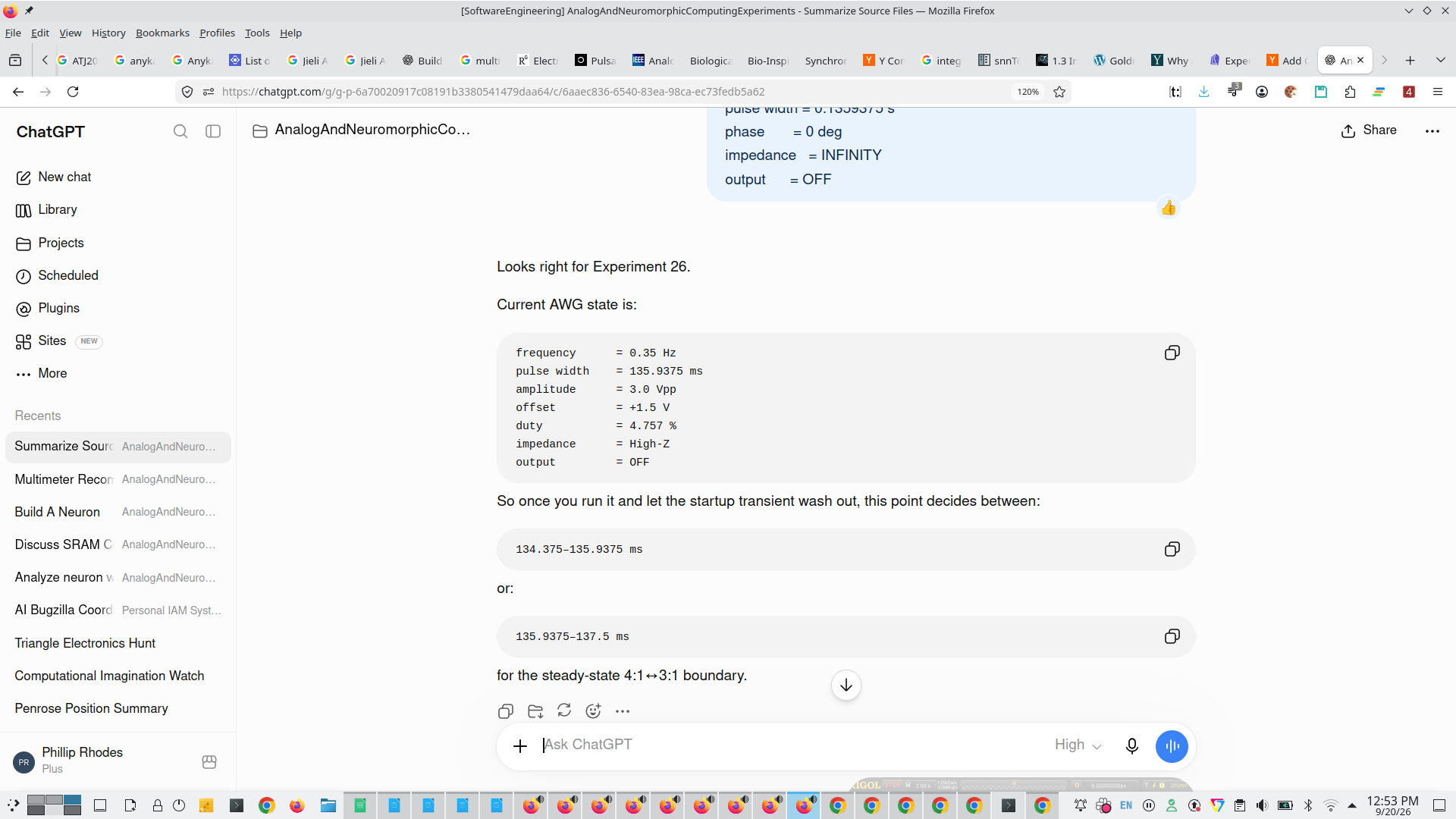
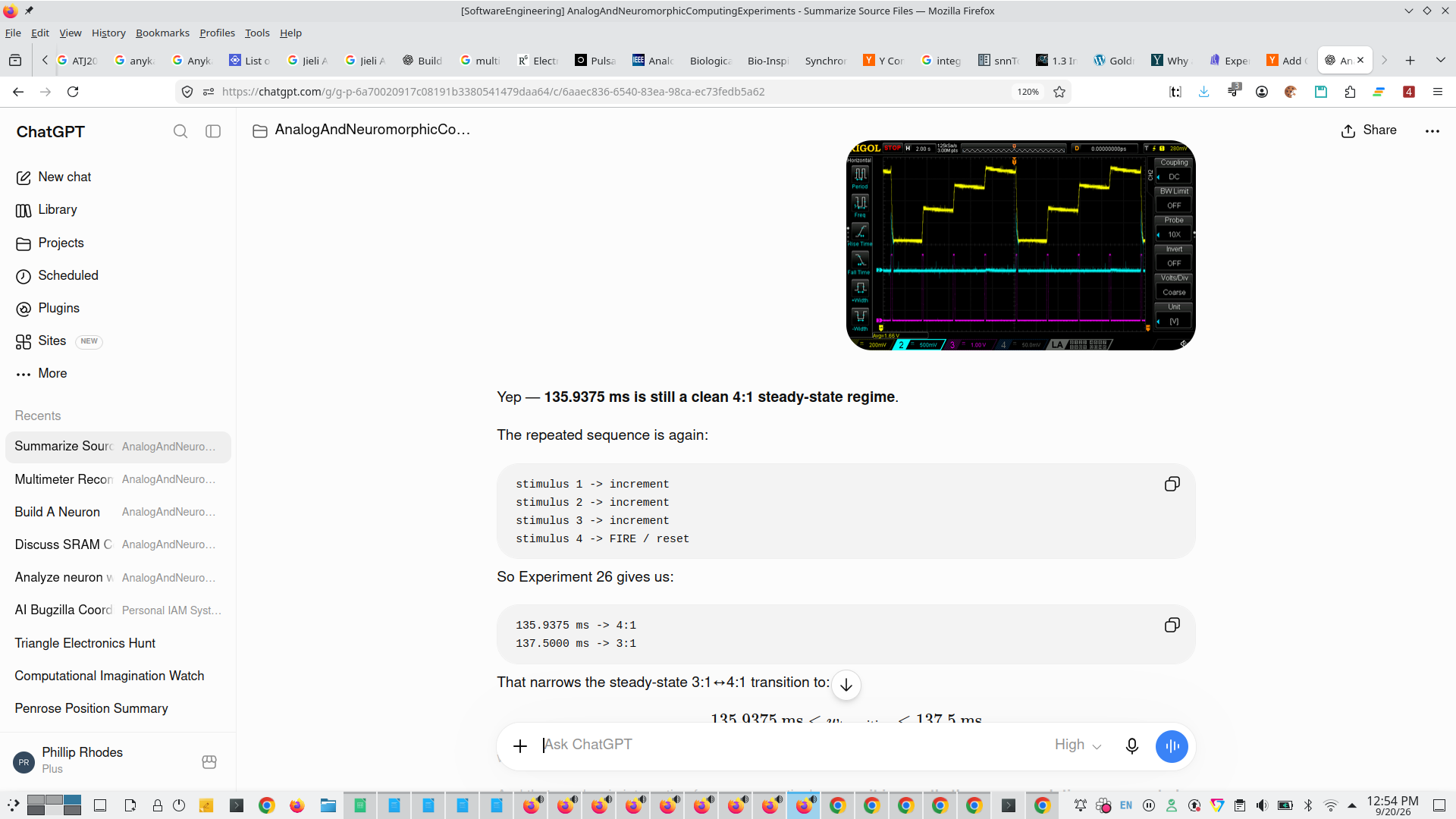
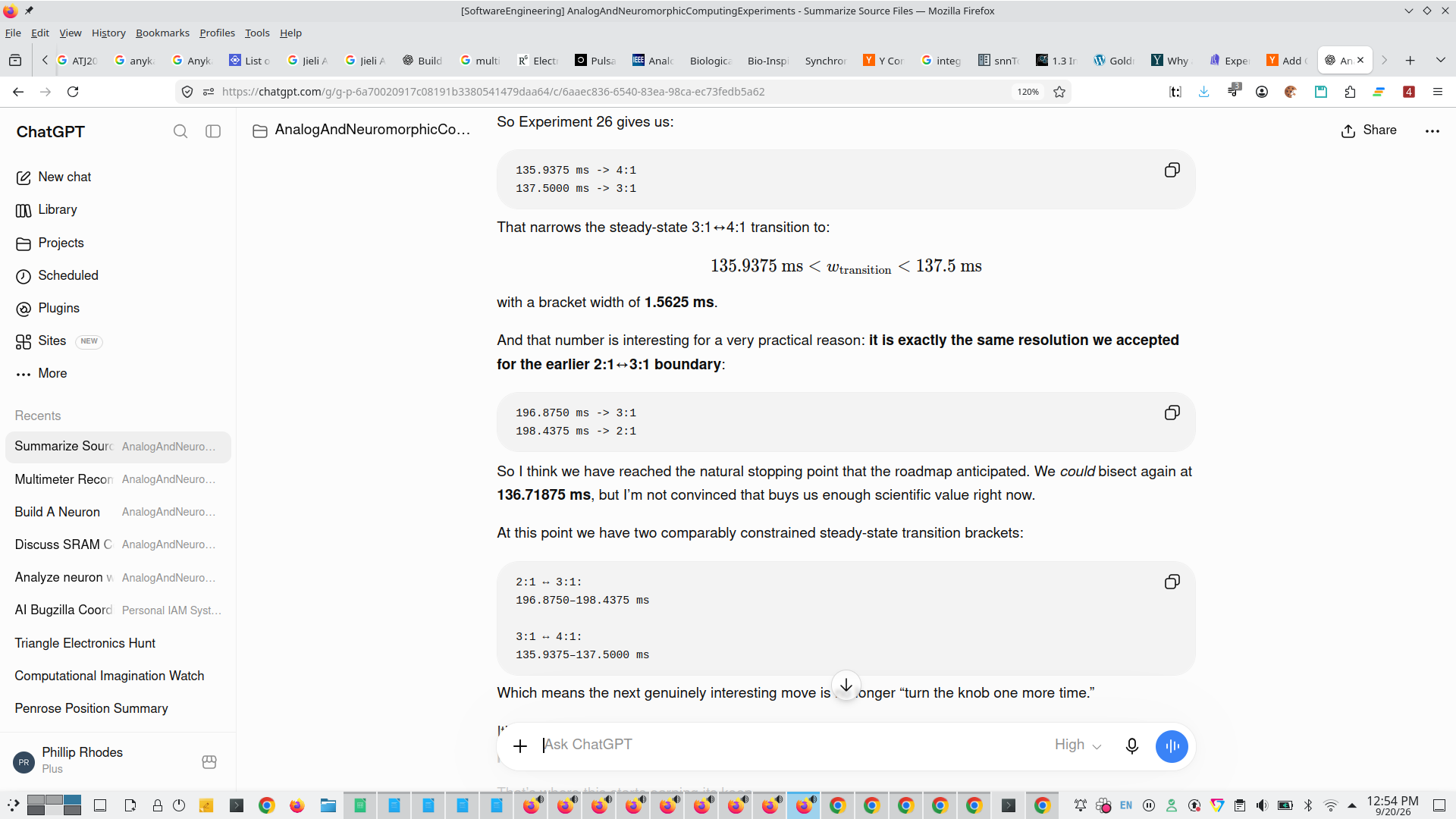
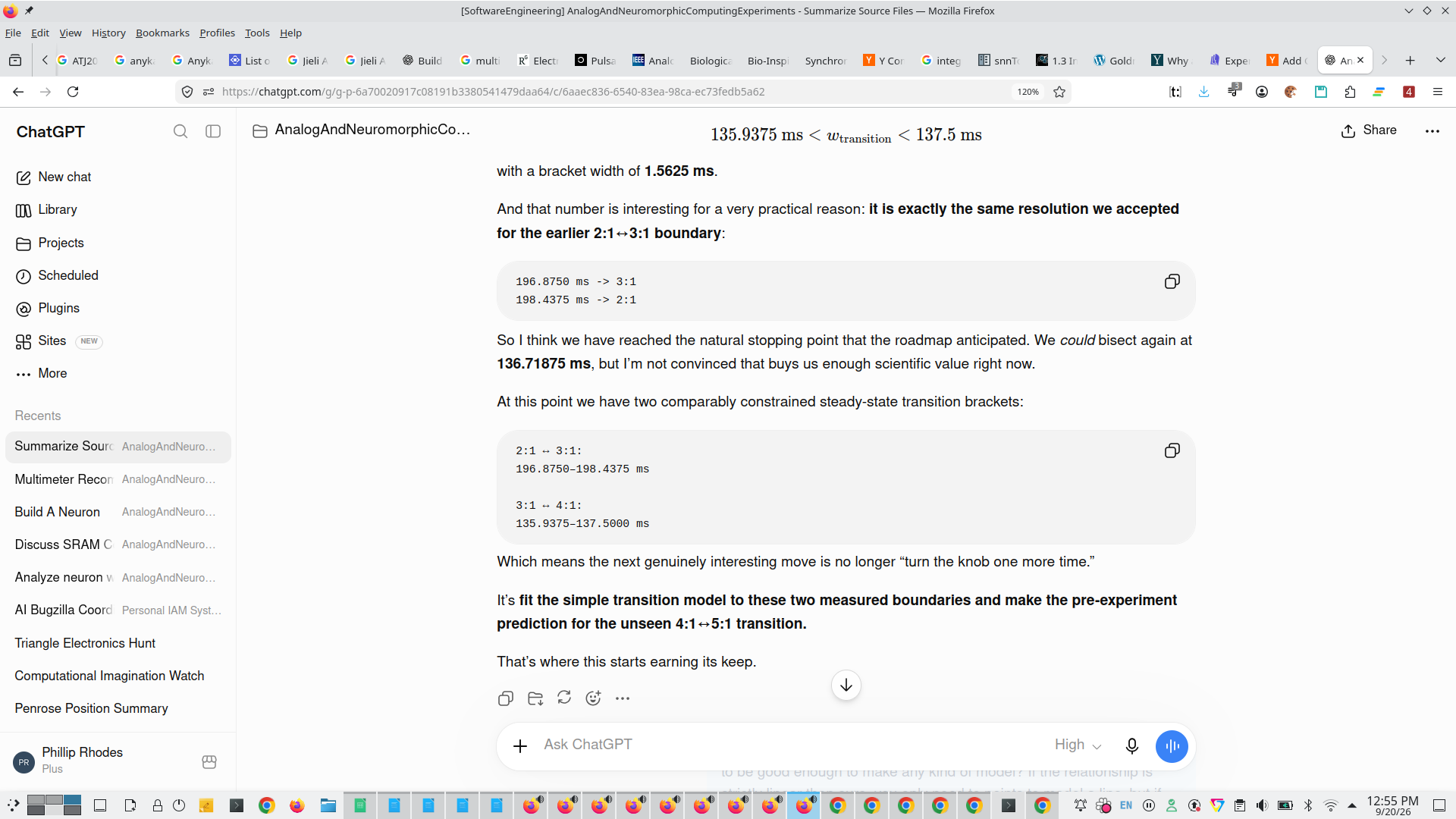
I'm working on a project, with a lot of help from ChatGPT, involving an "artificial neuron". That is, an electronic circuit, using a PUT, a capacitor, and some resistors, that simulates some of the behavior of a biological neuron. Specifically an "integrate and fire" model of neuron behavior. To that end, I'm running experiments by scripting my function generator to send signals to the circuit, and then capturing the inputs and outputs on my oscilloscope. Then I usually discuss the results with ChatGPT. In what follows, observe a couple of things:
1. The LLM "knows" the context of what we're talking about, even if I provide a prompt with no text at all, just an image.
2. It parses a moderately complex image, identifies the separate traces and what they represent, uses the time-base information displayed on screen, and the on-screen graticule, and works out "how many input pulses fire before an output pulse fires" and then reports back to me and gives an analysis of how that relates to our previous observations and gives suggestions for the next experiment to run.
Human intelligence? No. But I see no world where behavior like that does not count as "intelligent" regardless of the mechanism behind it. And that's probably not even the best example I could come up with, it's just something that was "top of mind" and for which I had the necessary images and what-not already ready, or easy to capture.
I think that the argument is not that it happened before LLMs. Rather, assuming I'm understanding the parent correctly, they are arguing that, due to the enshittification of search and the internet, LLMs are the only way to get information from it. That has definitely been my experience as well.



https://corpgov.law.harvard.edu/2012/06/26/the-shareholder-v...
https://www.legislate.ai/blog/does-the-law-require-public-co...
https://lawreview.law.ucdavis.edu/archives/56/5/end-sharehol...
https://news.ycombinator.com/item?id=20325023
https://en.wikipedia.org/wiki/Shareholder_value
So yeah, "fiduciary duty" is a real thing, but that's not quite the same thing as saying that every single decision has to be focused on nothing but profit maximization.
reply