I think elegance has to do with the technology of the time. Some clever design that is cheaper/better than you would otherwise think possible given the era. There are probably many elegant aspects to Roman aqueduct engineering, but they would still get replaced with modern materials during a retrofit.
Even if he were still CEO, a message of, "This sucks", he does not have to explicitly add, "Fix it, please". That is well implied by the hierarchy. Your boss notes a problem, underlings try to correct.
I can see why you might think this but I think it is incorrect. Particularly because he's not in the hierarchy. Billg is not the boss at this point and has no meaningful effect on one's job unless you are in the top dozen execs and even then this is just an email about a user experience, it's not a command. Ballmer is your boss and the old man yelling at the cloud can keep screaming into the wind. Point: did anything change from this email? I don't think so.
It is helpful for me to understand corporate dynamics and how they actually work (or as supposed to) instead of a simplified version from outside. My brother is a CEO of a big company so I get to hear it from his side. Doesn't mean I'm right, I'm not the CEO.
[edit: softened the language]
[another edit]
Actually he isn't the CEO anymore. Private equity purchased the company years ago and he was made CEO from outside but in the industry. Eventually the PE people wanted to cut everything to make the company look good for a purchaser so that means high earners in the company have to go (this is a highly technical company with PhDs and researchers, etc).
But guess what? Those are the people that make the company special among other things. They demanded he fire some top people. He wouldn't because it would destroy the company's value. So they fired him and put in one of their lackeys to do the slaughter. They kept him on in a different role that I won't say because I don't want to reveal too much. Flash forward the company has not sold and is likely to have lost 50% of its value. I admire him but since they were going to be fired anyway shouldn't he have sucked it up and got a better price for the company? The PE people were total jackasses so working for them another day was poison in his veins.
..the Audible is read by Wil Wheaton (some may be turned off by that alone)
Include me on that list. Man has no range, and a terrible falsetto he uses for women. He managed to get short-listed for the geeky novels I usually enjoy, and for a time, it seemed like I had a 1/3 chance of getting a Wheaton narration.
While I recognize it in other of his audio books... there are a few examples of women in the previews. I don't recall him using a falsetto in those books at all.
No, he doesn't have a lot of range... but I don't feel that's necessarily a show stopper for audible books in that I've more than occasionally experienced a reader who did have a lot of range... that sometimes went past the range of the speaker. He reads like an actor where everything it goes from a stage whisper to a slightly increased volume with a drop in pitch... and that often works (for me) compared to readers who its telling Alexa "pause, louder, back 1 minute" to get things that are read in a more hushed whisper.
My favorite bit about this is how none of the execs want to take ownership of the change, but instead trying to put someone else in the hot seat and/or start a Committee.
This feels like an email that should have been blasted to the entire company. Top-down, empower employees to think of a more unified experience. Then again, all of the external jokes about Microsoft indicate that every department is fighting for their lives against the others, so that kind of kumbaya togetherness was never going to happen.
This is unfortunately par for the course at many big companies. I have re-lived this exact same thread so many times I've lost count
1. Leader escalates issue to his team
2. The team scrambles to come up with a solution
3. No one wants to take ownership. #NotMyProblem
4. weeks or months are spent on 'developing a plan'
5. nothinghappens.jpg
I have seen that too many times too in big companies, but I wouldn't say that it results in nothinghappens.jpg
It results in the equivalent of treating an infection with Tylenol rather than antibiotics. The exact symptom reported by a "Leader" will usually get fixed, but in a more of a "KPI hacking" rather than a fundamental fix to the problem. I have seen a "Leader" point to the staggering number of support tickets as a problem then have teams make it incredibility difficult to open a support ticket. The number of support tickets plummets and the first report to instruct their team to do so gets rewarded and all other teams follow suit. Have a leader point to complexity of the sign up process, and have teams "simplify" the signup process by just taking an email to create the account, then make the experience of doing anything post sign up a broken mess because you forgot to go into settings and filling up all the required details. Or have a leader complain about the install process like in this example, and have teams just bundle massive dependencies or make wide horrific modifications to the users machine to "simplify" the install process. Now suddenly installing a video editing software also modifies your default video player, your HDR or scaling settings, your audio device setup, and your keyboard layout (because why not?)
I drown in support tickets daily that used to go nowhere. Then people started realizing that I knew what I was talking about and not some standard business user. Now I still have to open tickets, but get visibility of the people who know what they’re doing on their end (having been moved up from lowly support to oversee some ticket filling company that doesn’t know crap). We get tom complain to one another how shit is broken, wait mandatory change periods and then get something working by exploiting loopholes because some process was developed and someone put a lot of money behind it.
Large companies are why large companies are large (in IT/OT at least)
The more interesting question is why would so many thousands of people in a big firm seemingly be fine with frustrating customers and giving the appearance of a gaggle of clowns?
Standard psychology says they should be highly sensitive to status loss, but it almost seems the opposite.
Ask anyone at a FAANG and they will tell you that large corporations get flak every day for a lot of things, some justified and some unjustified. As an IC, you need to tune it all out and let the people whose full time job is to deal with that sort of thing handle it.
As you get larger there is a fire everyday and ever more competing priorities on which fires get put out.
How much money does movie maker bring Microsoft? Now which executive would want to prioritize movie maker so much that they would directionally alter the company to fix this? Consider the issue that the execs had was fixing all the issues involved a huge number of teams.
Discredit to Bill here but I honestly think he was the only one who had the power to fix this. A Jobs-like figure is the only person with the organizational power and freedom to drive details like this to completion. Anyone else would end up in a power struggle
>"The more interesting question is why would so many thousands of people in a big firm seemingly be fine with frustrating customers and giving the appearance of a gaggle of clowns?"
Existing in a large org over the long term becomes a game of survival. It's very much similar to the "dark forest" or the Eye of Sauron. Your number one goal as an IC is to complete the tasks directly assigned to you by a supervisor and avoid at all costs any kind of "hey you" assignments that have zero upside and plenty of possibility for downside. It would be wonderful if we lived in a world where individual initiative mattered and was rewarded, but it doesn't. It becomes "why haven't you delivered XYZ", and the vague ephemeral reasoning of "well A, B and C for team D needed fixing" is not an excuse, and now you can't pay your mortgage anymore.
You forgot the part where the leader gets more and more frustrated, it’s like a game of hot potato, if you’re the last one holding the potato when Leader finally cracks, all of it lands on you!
I’ve been in this situation in a small company as well. The owner wasn’t managing the company and there was no other manager. So the owner would express his frustration in an all hands meeting “I don’t like x” or “we’re going to do y from now on” but he would not assign the task to anyone, or give ownership. He would come up with some insane new goal but no plan, no equipment, and no one person who’s in charge of making sure the required resources, time and responsibility is assigned. So nothing would change, a month later there would be another meeting, with a middle aged man having a tantrum about why did no one do anything!? Why is no one listening to me?
You might be thinking it’s a good opportunity to accept some responsibility, it might get you a promotion or be a good learning opportunity. Yeah I tried that for a while, if you succeed, congratulations, you now have one new task for which you’re responsible for without any extra compensation or benefit. If you fail? Well guess who’s getting the blame..,
I have been this owner AND this employee, at different times in my career. As the employee, it's as you describe -- having goals described to the team without actual tasks being assigned to individual employees/teams is a recipe for things not getting done. As the owner (especially with a small team) nothing is more aggravating than having employees who sit around waiting to be told exactly what to do, with no real concern for how the company provides value for its customers; employees who think they're underpaid no matter how much they make and therefore do the bare minimum unless they're getting a bonus/raise/promotion.
Yeah I totally get it. In this situation you could see employees burning out because of the lack of management or leadership and the chaos of the company. Like everyone cared at first and tried real hard but eventually almost formed a learnt helpless. The implicit message was don’t try, just do the bare minimum and avoid trouble. We were also paid minimum wage. Many employees were doing unpaid hours as well.
If you provided leadership in your case then I think it’s different
I think the thing that really made it horrible is like I said. The boss would say x needs to happen but would not think through the details, buy the equipment, allocate the time or human resources. Someone still had to work out how to do those things and who was going to do what.
I’ve had “Boss I can fix this in one line of code.” situations, but nobody of 6 people wanted to make the call despite involving themselves excessively.
So nothing got done.
So the temperature on the issue went up.
So management whose failure was their own could only think of engaging more managers and processes….
Never ended.
I work at small companies now, less money but I enjoy it more. I just fix things and everyone is happy.
> This is unfortunately par for the course at many big companies.
Agreed. Even at companies known for having a great culture and being "different from the rest", the Game of Thrones politics is still there - it's just more hidden and polite. I was a senior exec in the biggest BU at just such an F100 valley tech giant for >10 yrs (one level from the CEO). The company actually did have a nicer environment than its peers, no 360 reviews, no 'up or out' mandates, and a vibe genuinely a cut above.
While the net effect was more pleasant day to day and teams were insulated a few more levels down than most places, the brawling over headcount, budget and revenue attribution was simply practiced far more artfully. Sadly, I think it's just endemic to the breed of "large public corp" and while the best may be better, none are immune.
Both will eventually develop a strict hierarchy where you're only accountable to people up the chain of command, not down. There is no way to prevent that because it's a lot easier to keep one person satisfied than a whole team you're supposed to lead, so almost every manager naturally switches to working that way.
The only thing that can prevent it is a flat organization but one that has enough structure so an unofficial hierarchy can't form. And making that work is hard.
In my experience it's kinda different. The serious issue that raised by higher up usually means more scope, visibility, bonuses and potential bonuses. Teams usually fights to get the important issues(whichever the higher thinks that's important) as their team's work. The drawback is that it's very possible that multiple teams are fighting for the same pie and resulting in duplicated work.
In the end if there are enough incentives(usually money) people would work on those.
I think you're leaving out a key aspect of the problem: not one of those people had the scope of responsibilities to really fix the issue. There was the website, windows update, and OS team, all being fed by a variety of product teams with marketing and delivery concerns. At root, Bill's problems were a coordination issue spanning half the organization. If you were on that email chain, you wouldn't want ownership either because that herding the rest of the cats towards a comprehensive fix that would probably restructure the whole company.
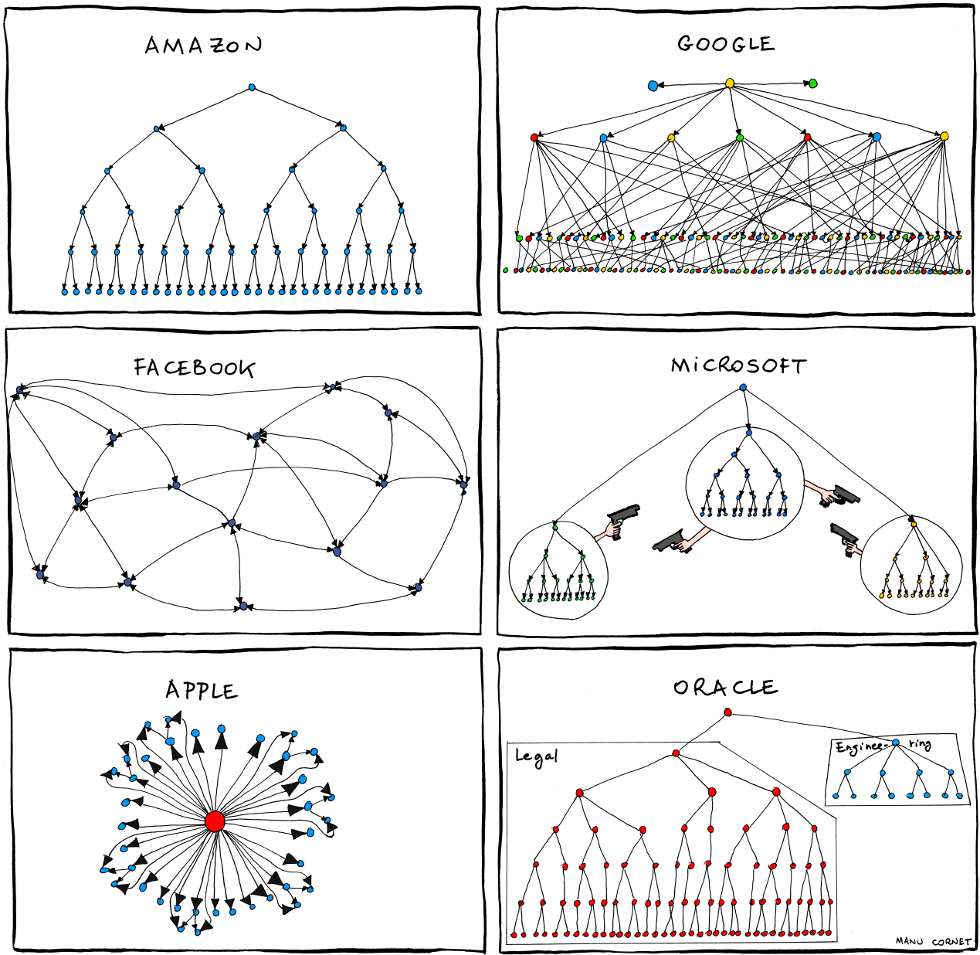
I love how Google looks like an MLP. I suspect their leadership would agree with that portrayal. You can imagine the activation functions: "Will this get me promoted?" "Will this get us bad press?"
> Someone decided to trash the one part of Windows that was usable? The file system is no longer usable. The registry is not usable. This program listing was one sane place but now it is all crapped up.
This is so true, and not only under Windows. Install any modern program under any modern OS and have a look at the filesystem, it's a flaming mess.
Nowadays the only solution "smart people" have found is to install a complete system, complete with libraries and frameworks, for each program.
One of my "santa's not real" moments of computing was realizing how much static and dynamic libraries fucking suck. This cannot be overstated, and is illustrated perfectly by the heroic efforts of software vendors to get away from them.
Okay, a few functions like fopen are fine - but even those are syscall wrappers IRL. But every OS seems to have concluded, that in the place of API calls, one should rather have streams of text (UNIX) or binary messages (Windows, also a bunch of Linux desktop stuff, like Wayland), or File I/O.
Basically a major motivation behind JIT langauges (C#/.NET certainly) was an effort to get away from dynamically linked libraries,
Even DOS didn't really have libraries, you had peripherals mapped to memory at certain addresses, and a set of interrupts, and that was it.
These single file Go and Rust programs read and write stdio and/or network, which is a reasonable solution to a lot of problems, but certainly not all of them, especially in the interactive space.
That's why I like the "managed" model Debian uses. Programs are enforced to comply to the OS standards. If they don't, they either get changed by the Debian maintainers or just not included into the distribution. That's why I can know where things are in my filesystem.
The difference in complexity between my go and my Python docker image is actually hilarious. 100s of files and package managers and npm and whatever else.. vs 1 file.
From what I know about MS, I can understand what they mean. Microsoft famously had teams at odds with each other, so if you "own" something across multiple teams and can't get them to actually work together or take a particular issue seriously, then you just have the shit end of responsibility without the authority to make stuff happen.
For awhile under Balmer, Microsoft implemented a lot of Jack Welsh management philosophies. This included stack ranking, but also encouraging "internal competition" under the idea that it'll drive people to excel. In real life that caused friction, politics, sandbagging, and other problems that were not in the company's best interests. It's fine to be competitive, but in some competitive situations (team sports, companies, etc), the whole point is for the team to win, not individuals.
Sadly, even though most of these philosophies have been discredited over the long term (stack ranking can be fine if you do actually need to do layoffs, so long as you realized there are exceptions to the rule), other bad management practices have also taken over. We're now squarely in the depths of all the worst aspects of "product driven" development, where nebulous metrics are measured for success (such as the bad VSCode decision to append copilot in commit messages, which makes it look like copilot is more heavily used than it is).
Ironically, they could have learned from Jack Welsh to separate the product divisions and make redundant teams on each one to solve the ownership issues.
When people compete internally on Microsoft, what are they competing on if everybody works in a different horizontal?
Exactly. Jack Welsh’s management philosophy just further incentivizes doing what you can to bring everyone else (ie the company) down to make yourself look better.
This comic was made a loooooonnnnnnggggg time ago (back when I worked at Facebook). It was actually a great place to work then, but that company no longer exists in any meaningful sense.
Well, except then the person who volunteered to "own website issues" clarified that they meant one specific issue (download links) among the five or so that Gates identified.
Given that the way the company worked was the cause of the problem, sending the email company wide would have caused more confusion that solve the problem.
Curious why it is so hard to find an owner to the issue. Gates' experience started with the web UI, then I'd expect that the team who owns the microsoft.com or owns the experience. To them there are only two types of bottlenecks: their web pages (usability, JavaScript performance, ways to get backend data, and etc), and their immediate dependencies. So, they drive improvement on both types of the bottlenecks, and the owners of the immediate dependencies recursively handle their own. For instance, the web team will identify that calling the catalog API has a P99 latency of 5 seconds and the network is fine, then they ask the catalog API to improve the API latency. If the catalog team does not do the obvious, the team's manager gets punished.
Of course, I'm being naive here, as I've seen too many companies fail to achieve such basic ownership. So, curious what I have missed. Of if the ownership is not a clean DAG, well, it goes back to Gates, as he was responsible for both the org charts and the company culture.
It wouldn't surprise me that what seems like whole things from the outside are split up even further on the inside of Microsoft. There's probably no single person responsible for microsoft.com (nor was there at the time). Instead the front page is one team, Windows Update (at the time) was yet another team, and sales another, and then there are 5 other teams doing other things, and no single individual or group is responsible for the whole thing. They've all got permission to push things to the website and change whatever just from time immemorial, and not through any defined authority, since that authority doesn't actually exist.
You can still see symptoms of this today. MS will (or at least would) spin up new domains rather than just update microsoft.com, or create newthing.microsoft.com, since both of those require talking to whomever is responsible for the main domain. Even if that person exists, knowing who they are in an org like MS is already a big ask when it's organised the way it is. Meanwhile, buying a new domain likely takes less than an hour, even if you include billing and such.
> My favorite bit about this is how none of the execs want to take ownership of the change, but instead trying to put someone else in the hot seat and/or start a Committee.
And with the exception of John Martin's reply (which recognizes that there are deeper problems they should think about, but seems resigned to the fact that that won't happen) the focus is pretty much entirely: "let's fix the exact issues Bill Gates ran into trying to download this one product we produce" (out of many hundreds/thousands) rather than "let's fix the root causes that caused us to arrive in this place to begin with".
I haven't worked at any companies as large and siloed as Microsoft, but I'd assume this is pretty common for them, at least if they don't have a Steve Jobs-like tyrant who both has all the power and is singularly product focused.
There was nothing surprising in that email chain at all, looking at it as someone with lots of experience in large companies.
In a twisted kind of way, the replies were reasonable and logical. They're not dumb, they can see it was crap. No one org can actually own this fix, so in that kind of situation it realistically requires someone like Bill to choose someone to drive it, and demand updates to ensure that everyone gets aligned. Telling his execs, especially in a company so notoriously political and "empire" oriented as it was, isn't going to work.
I actually liked that in Amazon, Jeff Bezos used to send out the infamous "question mark" emails on such a regular basis that they built an exec commitee specifically for the purposes of driving direct action on problems. Didn't matter where you were, or what you were working on, if that question mark email came you dropped everything to work on it.
I think they also suspect/know that Gates won't revisit the issue. The email is a flame as the subject line admits. Gates wasn't going to go back every week for the next six months to track progress.
I mean, you're 100% right, but what's the alternative? They wanna keep the salary. The machine rewards political people, not people who pick fights to improve the product. It's a perfect pair. :/
>In a twisted kind of way, the replies were reasonable and logical. They're not dumb, they can see it was crap. No one org can actually own this fix, so in that kind of situation it realistically requires someone like Bill to choose someone to drive it, and demand updates to ensure that everyone gets aligned. Telling his execs, especially in a company so notoriously political and "empire" oriented as it was, isn't going to work.
This goes right back to the leadership failure on Bill's part. If your company is structurally incapable of producing good products (which Microsoft assuredly is and still was) then it's on you as the CEO to implement the correct structures.
That's literally the purpose of upper management: you create the conditions for success to happen.
It's very common. From a certain level up, execs rarely use the products they are responsible for. It's all about strategy, committees, meetings, plans and reports. For them the product is just an abstract thing. When I rented a Buick car, I thought to myself that there is no way any decision maker ever tried the car and thought that this is ok.
I think one of the strengths of Apple during the Jobs days was that Jobs actually sometimes seemed to use the products himself and gave feedback. When I look at the blatant bugs MacOS and iOS had in the last years, I also think that the current Apple big shots never use their stuff or they would have noticed.
If you'd take the Gates email and give them to my colleagues, saying "this was some random guy complaining about Windows", they'd all react along the lines of "Well, that's just an idiot who makes things up because he's bored and hates Windows. There are good reasons for everything he complained about. He just reports it in a quite dramatized way."
> When I look at the blatant bugs MacOS and iOS had in the last years, I also think that the current Apple big shots never use their stuff or they would have noticed.
The crazy thing is that it's more likely that most people in Apple are using their own products, versus any of the Android phone manufacturers or within Google, where it's likely a few of them would be using the Apple ecosystem instead.
Many of them are definitely dogfooding it, but it's possible that there are communication or empowerment issues.
One thing that drives me nuts for example is the indicator for remaining disk space. I have this icon on my desktop that says "Macintosh HD | 995 GB, 273 GB free". This used to work great until a few years ago. Copy 1 GB onto the disk and it displays 1 GB less free disk space.
But since a few years it goes up and down daily by 100 GB or more. Sometimes I have 350 GB, sometimes I have 100 GB. I think it has to do with Time Machine snapshots and purgeable space (whatever that means) but it's totally useless now. I can't tell for sure if I can copy 250 GB to my disk or not. It may fail now but work 2 hours later. How come nobody notices such a fundamental thing not working? Somehow the dogfooding doesn't seem to work. Or maybe the Apple people all have 8 TB disks so they don't care.
> I haven't worked at any companies as large and siloed as Microsoft, but I'd assume this is pretty common for them.
Doesn't need to be that large, I worked for a company that ~4500 employees with about 1000 at HQ, that entire email chain looks exactly like what would ensue every time someone at the C-level flagged an issue.
I suspect the reason is much the same, no one wants to be in the hot seat to fix a problem they have no faith they can fix so everyone plays hot potato with the flaming sack of shit until it bursts and lands on someone.
> Fish begins to stink at the head, not the tail. (13th Century Persian Proverb)
Also I suspect that there's no real teeth in that angry email.
If the big boss is frustrated by the UX, they might send an angry email or even yell at you in person. If your division doesn't meet its sales projection for the quarter, you might get fired.
If BillG had wanted a company that made good user experiences, he'd have hired (and fired) for that. Sending a pissy email is what you do when you're annoyed but don't actually care enough to do anything about it.
Agreed. From the comments, lots of people down-thread who clearly haven't worked in large orgs.
They are arguing about not wanting to take ownership because they know the organizational structure is going to be an impediment. The problems Bill describes could not have been solved by Microsoft without a massive internal restructuring. We know this because Microsoft's UX is still abysmal.
Nobody wants to have the inevitable failure hung around their necks by "owning" something that depends on the cooperation and coordination of departments that don't report to them.
In addition to some of the other great answers, it is cheap enough to lose. The unexpected breakage/theft of a cellphone ranges anywhere from annoyance to world ending disaster. So, I have to be a lot more deliberate in protecting my valuable phone.
The tiny ereader contains no secrets or valuables, so I feel fine pulling it out in an area where I might otherwise be reluctant to use my phone.
How usable are the BSDs as a GUI daily driver? Like 99% of Linux applications work out of the box or more like 50%?
With new CVEs being discovered in ancient bedrock code on the daily, it seems prudent to switch to a NetBSD/OpenBSD/Qubes system for the next few years until some vulnerabilities might get smoothed over.
I use FreeBSD on all my machines for everything sinc about 11 years GUI is I3/X11/AMD-Card everything works, but please test it yourself, it's like with linux, you just know what's not/is working if you use it daily for all your edge-cases (maybe your scanner, maybe your barcode-scanner your Bluetooth-Stuff your wireless etcetc)
Overall i really love FreeBSD for everything computing (Pi/Laptop/Workstation/Servers).
And the community is great...wanna make a port/src-patch?...just send it to the bug-tracker, no rituals needed ;)
they get accepted or rejected, updating ports/packets would be a wonderful AI job, check newest version, update port, poudriere the thing, test it, make patch, send to bugtracker.
Maybe the AI can even check "funny" upstream commits like it happens with npm/crate and block that stuff.
But FreeBSD ports is incredible up to date so there should be no flood of patches anyhow.
Indeed. This might be naive but it would be grand if projects could have their own models and compute with which to perform these and other tasks, each trained as per the project's ethos/needs.-
This is way too expensive. Models are an inherently centralizing technology, and there's no future for niche projects that don't make up a big part of the major providers training sets.
It has a working X11 with DRM from linux as base so everything graphical will work mostly fine. The issue is more around the OS and some subsystems. OpenBSD is still using the Giant Lock model, so SMP can be an issue. Linux has more independent subsystems so heavy processing is unlikely to impact usb audio (which is an issue I have with my oldish laptop). Another issue is the input subsystem (wscons framework) which is not as sophisticated as Linux Input subsystem. In general, linux subsystems are more sophisticated/complex than their OpenBSD counterpart, but the latter work well enough.
There are some linuxisms in some applications (the recent moves to wayland/systemd,...) but they're mostly easy to port.
Depends on what you need. Software compatibility is mostly good, as long as it doesn't have a dependency on systemd or some other Linux-specific feature. Driver support varies, but FreeBSD in particular is pretty decent there.
FreeBSD has a Linux compatibility feature that lets you run native Linux binaries. I've never used it so I can't say how good it is, though - all the stuff I use runs fine natively.
The major BSDs have decent package management and sizeable repositories, with the option to build software (and customize compile-time options) using the ports or pkgsrc systems. You can also rebuild and customize the kernel and base system (aka "make world") but that's strictly optional these days.
I seem to remember there was some GNOME stuff that had a hard systemd dependency and wouldn't run on the BSDs. That was a while back though and I don't run GNOME so I don't know whatever happened there or what the status is.
FreeBSD does, but I haven't tried it. It has its own chapter in the handbook. No idea about the others. I rarely need to run Windows binaries so I'm not the best person to ask.
NetBSD 11 with Firefox 151 from pkgsrc on a custom CTWM is a usable daily driver for Emacs daemon mode GUI/TUI and console tmux simultaneous use. Remote in from a Windows or macOS desktop.
Surely on cultural impact Harry Potter has to win. While GoT had a decade flash in the pan, Harry Potter is still deeply in the cultural zeitgeist. "Muggles", "You're a Hufflepuff", etc have become cemented into our vocabulary.
GoT is undoubtedly more complex, interesting world, but it never had a generation of children reading the midnight book release. That the author actually penned the series finale is also worth something.


reply